
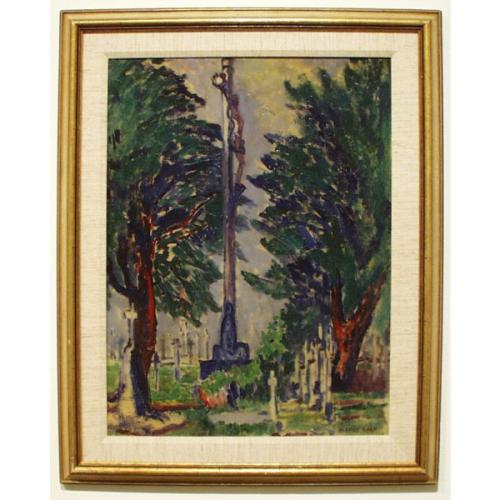
Emily Carr
Canadian, 1871 - 1945
Emily Carr was born on December 13, 1871, in Victoria B.C. She was born into a large family of nine children. Carr lived to be 74 and passed away in 1945.
Richard Carr, Emily’s father was a major influence in her life. He encouraged her creativity and free-thinking. For example, Emily and her sisters were educated in the public school system instead of private schools that taught proper decorum and behaviour for young ladies at the time.
When Carr was 19, she moved to San Francisco to study art at the California School of Design. She was not able to complete her program due to the family’s financial difficulties and returned to her hometown of Victoria, B.C. Carr then taught art classes; the income allowing her to continue her studies abroad. She spent her early adult years living and studying art in Paris, France as well as Cornwall in the United Kingdom.
In the mid-1910’s, Carr began her work studying Totem Poles in the Northwest Coast of B.C., in particular the villages of Gwaii and Haida. The images of Totem Poles became synonymous with Carr’s artistic style. However, Carr’s work was not without controversy because she interpreted the cultures through a white settler's view.
Although closely associated with the Group of Seven, Carr was never an official member.
Richard Carr, Emily’s father was a major influence in her life. He encouraged her creativity and free-thinking. For example, Emily and her sisters were educated in the public school system instead of private schools that taught proper decorum and behaviour for young ladies at the time.
When Carr was 19, she moved to San Francisco to study art at the California School of Design. She was not able to complete her program due to the family’s financial difficulties and returned to her hometown of Victoria, B.C. Carr then taught art classes; the income allowing her to continue her studies abroad. She spent her early adult years living and studying art in Paris, France as well as Cornwall in the United Kingdom.
In the mid-1910’s, Carr began her work studying Totem Poles in the Northwest Coast of B.C., in particular the villages of Gwaii and Haida. The images of Totem Poles became synonymous with Carr’s artistic style. However, Carr’s work was not without controversy because she interpreted the cultures through a white settler's view.
Although closely associated with the Group of Seven, Carr was never an official member.